Saturday, 14 May 2011

Bob Chapman The International Forecaster Blog

Bob Chapman The International Forecaster Blog

By Bob Chapman, May 11th, 2011.In legislation just proposed, and I don't know by whom, nor do I have a number yet, the Dept of Labor has proposed a re-definition of who is a fiduciary, not under the Securities laws, but under ERISA, the law that governs tax advantaged retirement accounts, such as 401K and IRAs and it probably will include all retirement assets, we don't have a definite direction yet of what they intend to do but it is my guess they want to limit those investments only to US government debt. They may include some blue chips or funds, I don't know. They may allow other high-graded fixed income products. These DOL-ERISA rules override all SEC rules. We don't know the final form of the legislation, nor do we know whether it will be passed, but my guess it will be. The government desperately needs to get those retirement funds invested in government debt. I would seriously think about terminating 401ks and IRAs by transferring the assets -- without commission -- into a personal account it then becomes a taxable event. I also believe there is a good chance that taxes will be higher next year. There is also an outside chance that retirement assets could be frozen -- such events would be negative on the general market because government would be directing brokerage houses to sell retirement assets. This is all in the planning stage, but it is very real.
http://theinternationalforecaster.com/


All information on this website is for educational purposes only and is not intended to provide financial advise. Any statements about profits or income, expressed or implied, does not represent a guarantee. Your actual trading may result in losses as no trading system is guaranteed. You accept full responsibilities for your actions, trades, profit or loss, and agree to hold MinKL Invest harmless in any and all ways.

Friday, 13 May 2011

Dollar With Nothing to Replace It

Demise of the Dollar With Nothing to Replace It

Although Standard & Poor’s downgrade of the U.S. rating outlook to negative caused nothing more than slight and short-lived turbulence on the markets, it very well may have long-lasting serious consequences. Indeed, no new information was released since everybody was aware of the persistent U.S. budget deficit and mounting debt. Hence, the market reaction was very moderate, the dollar continuing its gradual slide, driven by fundamental factors, which also helped inflate commodity prices.
It looks as though markets that are awash with liquidity have developed immunity against such shocks. Even Japan’s nuclear disaster and political instability in the Middle East and North Africa were unable to undermine market confidence as much as last year’s debt crisis in Greece. The fact that the markets are now less sensitive to negative news clearly illustrates that they are in bubble territory, even though the bubble is not as significant as it was before the 2008 crisis. Consistently loose macroeconomic policy in the United States and euro zone, which results in permanent liquidity injections, is helping to inflate it to a greater extent than it is helping to stimulate growth.
When growth is organic, it does not need any artificial stimulus.
A very volatile but gradually falling dollar has become very inconvenient as a global reserve currency. Indeed, holding reserves in currencies that represent a negative real interest rate environment, such as the United States, is not the most efficient way to save.
The problem for the majority of reserve holders is that the dollar has no real alternative at the moment. Although the euro was able to acquire some credibility in the past decade, many analysts — mostly in the United States, as would be expected — challenge the reliability of a single European currency. Their chief arguments are that the euro zone is equally overburdened by debt problems, it is accompanied by sluggish economic growth, and there is little flexibility in decision making.
Unsurprisingly, faster-growing emerging economies, such as Brazil and China, are trying to protect themselves against external volatility by either introducing various forms of capital controls or targeting the exchange rate. This is true, although to a lesser extent, in some other large emerging economies, such as India and Russia. (The term “emerging” cannot be fully applied to Russia, however, as its per capita gross domestic product is higher than in the other BRIC countries.)
While many emerging economies have attempted to limit local currency appreciation in nominal terms — sometimes unsuccessfully, as with the Brazilian real, which has gained 17 percent against the dollar since May 2010 — it was and will be virtually impossible to withstand real appreciation against major reserve currencies like the dollar, euro, pound and yen. This is another argument against holding your reserves in currencies that are depreciating against your own. Hence, the share of advanced economies in global GDP will keep shrinking.
The combined GDP of the BRICS, which now includes South Africa, in 2010 was comparable with that of the United States and the combined GDP of the 17 countries using the single European currency, including Estonia, which joined the euro zone on Jan. 1. Moreover, the combined GDP of the BRICS countries is expected to exceed the combined GDP of the euro zone already this year or next.
The recent BRICS summit demonstrated that this union is becoming increasingly institutionalized. After South Africa formally joined the group, it now represents four continents. Despite obvious political differences and varying geopolitical interests, there has been increasing political cooperation among member countries, as seen in the case of Russia and China, which have often coordinated their efforts in the United Nations and on various other occasions. As a result, we now have three roughly equal major economic formations by size of GDP, but only two currencies that can be treated as global.
What also unites the BRICS nations is that they hold about $4 trillion in international reserves and are quite uncomfortable with ongoing market instability and expectations of either potential weakening of the dollar or problems in the euro zone. Hence, the idea of replacing the dollar with some synthetic currency, such as the International Monetary Fund’s special drawing rights, or SDR, which has gained support within the BRICS. But the idea is facing strong opposition from developed countries, making it rather unlikely that SDRs will become a new reserve currency any time soon.
Moreover, the entire concept of a synthetic reserve currency is rather questionable and faces a number of technical aspects, such as capital controls and exchange-rate targeting in some countries and a lack of coordination of macroeconomic policies among potential founding members of the future currency union. Nonetheless, in the current environment of growing dissatisfaction with existing reserve currencies, creating some synthetic currency might garner more support, especially if it is established by the five BRICS members and even if initially aimed at a limited number of mutual transactions.
Indeed, in this case, the new reserve currency may be backed not only by the economic potential of the BRICS countries, but by their international reserves and low leverage as well. The latter is a stark contrast to the United States and euro zone, where mounting debt problems are making investors from emerging countries nervous and suspicious about the future of the currency issued by a country with a debt-to-GDP ratio of about 100 percent.
The gap between the idea of any synthetic currency and its materialization can clearly be quite broad, but the longer macroeconomic policy remains unsustainable in the United States and major European countries, the greater the chance that policymakers will start more actively thinking about better synthetic substitutes to the dollar and euro.
If some action is taken in this direction, it would further weaken existing reserve currencies, as often happened in the past when not the value alone, but also the importance of the currency diminished as debt problems mounted, such as with the British pound after World War II.
Yevgeny Gavrilenkov is chief economist at Troika Dialog


All information on this website is for educational purposes only and is not intended to provide financial advise. Any statements about profits or income, expressed or implied, does not represent a guarantee. Your actual trading may result in losses as no trading system is guaranteed. You accept full responsibilities for your actions, trades, profit or loss, and agree to hold MinKL Invest harmless in any and all ways.

Thursday, 12 May 2011

The False Myths of Gold & Silver Bulls....

http://www.24hgold.com/english/contributor.aspx?article=3482271866G10020

The False Myths of Gold & Silver Bulls Promulgated by Gold & Silver Bears

by JS Kim - SmartKnowledgeU

Published : May 12th, 2011

For those that think gold and silver bulls are perpetually long gold and silver no matter the present condition of the PM markets, that is a patently false notion. In light of the recent steep silver correction, an asset that periodically has steep corrections every year (the majority of which are induced and engineered by corrupt bankers) does not a bubble bursting make. Personally, I have been a gold and silver bull since 2005 (admittedly a little late to the party but still far enough ahead of the curve). Since that time, I have grown to know many precious metals bulls that were bulls for an even longer period than I. And what I’ve learned is the following. Those among us that understand the Central Banker effort to transfer wealth to the top 1% of people in their country through their Ponzi reserve fractional banking schemes, their constant schemes to devalue fiat money, and their unfair manipulation of stock markets, have NEVER advocated staying long at all times in all precious metal assets during the current gold and silver bull. Despite bankers’ allowances for paper gold and paper silver to be substituted for physical gold and physical silver in their Exchange of Futures for Physical (EFP) transactions and their clever invention of unregulated paper derivative commodity products that are hardly backed by any physical product, gold and silver has rebounded every year from banker attacks to keep trending higher. And the uptrend is still not only intact but it is intact and strong.


In fact, among all those I know that have been long-term gold and silver bulls for at least 6-10 years, all of us adequately manage the volatile downside engineered manipulation of gold and silver futures quite well most times with temporary hedging strategies that combine shorting gold and silver, cashing out, and/or buying puts on mining stocks/ETFs. Yes the intelligent silver/gold bulls among us will always have core positions in gold/silver whether that core position consists of just the physical metals, a fraction of the mining shares, or a combination of both physical and mining shares. But the intelligent silver/gold bulls will also fully expect banker manufactured price suppression schemes executed against gold and silver to occur every year without fail as well. However, since we have understood this global fiat monetary crisis for so long and have accordingly been precious metal bulls for many years now, due to our cost basis in gold and silver that remains far below the banker-manufactured steep drops in the price of paper gold and paper silver, the recent steep drop in silver is rendered nearly irrelevant (for example, for my newsletter subscribers that have been with me since the launch of my newsletter, the cost of silver, even after this dip, at $38 a troy ounce today, is still more than a couple hundred percent above our cost basis).


For some odd reason, gold and silver bears often assume that gold and silver bulls are unidirectional traders that always buy gold and buy silver no matter what direction gold and silver are heading and that they continue to blindly buy into short-term peaks. This assumption, besides being patently false, is an assumption with very little merit. Sure, there may be some among gold and silver bulls that buy heavily into short-term peaks but there are likely far more investors, from a historical perspective, that have heavily bought into short-term peaks in major stock market indexes right before they collapsed than those that have committed the same error with precious metals markets. Consider this April 23, 2008 article in which I warned of a very strong possibility of an imminent severe crash in US markets. Just 18 trading days after I posted the article, the US markets began a 50% decline, yet the majority of comments that followed my article reflected very strong bullish sentiment towards the US markets. I consider myself a gold and silver bull yet have never suffered huge losses even in years when my newsletter portfolio has been heavily over weighted in gold/silver mining shares and gold/silver mining shares ended the year heavily down. For example, in 2008, when stock markets crashed, I managed my Crisis Investment Opportunities newsletter so that it still returned a small gain versus the very large 38%+ losses of most global major indexes and the very substantial -28.56% loss of the PHLX Gold/Silver Sector Index. In the following year, when the PHLX Gold/Silver Sector Index rebounded significantly and returned a very substantial +37.55%, I still managed the downward volatile periods in gold/silver to end the year with an even greater +63.32% return. A couple of weeks ago, on April 26, 2011, I sent a very comprehensive warning to my Platinum Members. A very brief excerpt of that warning is below:


“I can’t see the bankers letting this opportunity go to waste, now that they have sold down silver by 10% already…As they say, to catch a criminal, you have to think like a criminal, so here is what I think will transpire the rest of this week. If I were a banker, silver at $50 absolutely mortified me and gold over $1,500 further mortified me. If I were a banker, I knew that if I didn’t cap the rise yesterday, there was going to be no way out from the huge short positions I hold in gold that expire in June and the huge short positions I hold in silver that expire in May and July. Thus, my best plan, and probably only hope, to exit those gold and silver short positions, is to attack gold and silver right now. Furthermore, if I were a banker, I would also take down mining shares as much as I could right now to keep people from investing in them in the future, especially with all the talk about the underperformance of the mining shares’ performance when compared to the metals. Drag down the mining shares now and that should keep people out of the mining shares for a while.”


For More GoTo   http://www.24hgold.com/english/contributor.aspx?article=3482271866G10020

All information on this website is for educational purposes only and is not intended to provide financial advise. Any statements about profits or income, expressed or implied, does not represent a guarantee. Your actual trading may result in losses as no trading system is guaranteed. You accept full responsibilities for your actions, trades, profit or loss, and agree to hold MinKL Invest harmless in any and all ways.

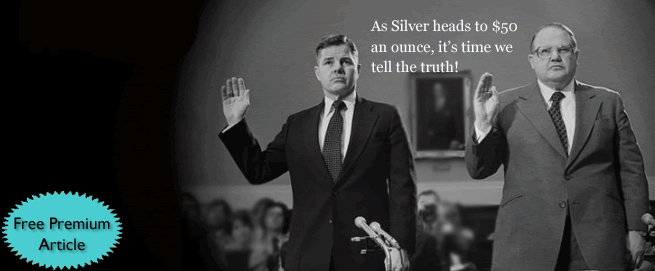
Hunt Brothers $50 Silver Truth....They Capped Gold.

Hunt Brothers $50 Silver Truth, How They Capped Gold…Yes, GOLD!

Commodities / Gold and Silver 2011Apr 13, 2011 - 05:36 AM

It began with a shoot-out at the Circle K Ranch. The 12 best marksmen would ride shotgun as the world’s largest, privately owned stockpile of silver was secretly transferred into secure vaults.
No, this wasn’t a shipment from Nevada’s Comstock Lode to San Francisco in the Wild West of the 1870s. This was the 1970s, and the precious metal was being moved from New York to Switzerland.


Shining silver under a moonlit sky, three unmarked 707s waited at LaGuardia Airport. The Circle K cowboys stood guard, shotguns in hand. 40 million ounces of bullion—amassed by Nelson Bunker and William Herbert Hunt—were loaded in, and the planes took off under cover of darkness to their secret destination…
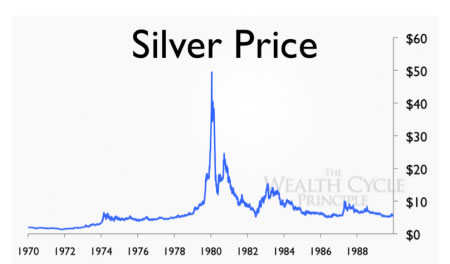
Millions of people have heard the “official” story of how the larger-than-life Hunt brothers drove the price of silver from under $2 an ounce to over $50 in an attempt to corner the market. At one point, the two colorful Texas oilmen owned the rights to more than half the world’s silver supply. But then it all came crashing down on Silver Thursday, March 27, 1980, when silver fell to under $11 an ounce. Instead of making billions, the richest men in America ended up losing the bulk of their family’s fortune.
The Hunt Brothers—Sacrificial Lambs in Wolf’s Clothing
I’ve been studying the Hunt Brothers, and I have a different take on what really happened. Because of the way they flaunted their wealth, because of ties they had to the Middle East, and because they did invest so heavily in silver, the Hunt brothers were the perfect scapegoats for the anger and frustration most Americans felt towards the lagging economy of the day.
I believe that Bunker and his brother were used by the Federal Reserve, in collusion with COMEX and the Chicago Board of Trade (CBOT), to cap the price of gold—YES, GOLD—and save the U.S. dollar.
Inflation Indignation
The period leading up to silver’s spike was fraught with inflation, stagnant economic growth, and political upheaval. In 1965, President Johnson increased deficit spending to finance his Great Society programs, tax cuts, and an unpopular war in Vietnam.
In 1971, realizing that the U.S. Treasury didn’t have enough gold to redeem all the dollars held by foreign governments and investors, President Nixon pulled the United States off the Bretton Woods monetary system—the last vestiges of a pseudo gold standard. This action effectively created a worldwide fiat currency system that continues to this day.
OPEC-generated oil shortages, along with real food shortages, fueled public fears that the U.S. economy was in crisis. By the late 1970s, inflation had become public enemy number one.
The Hunt for Silver
The Hunt brothers could see the writing on the wall. With their great wealth being steadily eroded by skyrocketing inflation, they needed an asset to which they could safely anchor their massive oil fortune. At first, they thought of gold—history’s safe haven. But in 1973, U.S. citizens were not allowed to own gold, and Bunker Hunt thought the gold market was too easily manipulated for government purposes.1
So the Hunt Brothers turned to silver, and started buying it at about $2 an ounce. Total world silver production was dropping, while industrial silver consumption was exploding. And once government and private silver stocks ran out, the shortfall between supply and demand was certain to drive the price of silver skyward.
By early 1974, the Hunt brothers had purchased futures contracts (agreements to purchase commodities in the future at a pre-determined price) for another fifty-five million ounces of silver. This was on top of the massive hoard of physical silver they already owned.2 In April, Bunker Hunt stopped in New York to visit the COMEX trading floor for the first time. When he walked onto the floor, the normal frenzy of activity came to a screeching halt. Who was this fat Texan in thick plastic glasses and a cheap blue suit? Rumors began floating that the Hunt brothers were attempting to corner the market.
Those who believe that the Hunt brothers were out to corner the silver market point to Bunker and Herbert’s huge appetite for silver futures as proof that they were trying to manipulate prices. I see it a different way.
The Hunt brothers used their positions in silver futures to acquire more of the physical metal. Aware that cash was continually losing value due to inflation, they settled their futures contracts with physical delivery of bullion, instead of cash, as a hedge against the government currency monopoly and global turmoil.
I believe that the Hunt brothers were more concerned about long-term survival and preservation of their family’s wealth than they were with short-term speculative profits. That would merely have added a few more paper dollars to their vast sums of rapidly depreciating currency. Bunker Hunt was well versed in Germany’s disastrous hyperinflation of the early 1920s, and he was genuinely concerned about going broke holding paper assets.
In an interview with Barron’s financial magazine, Bunker kept quiet about his silver investments. But he made no secret of his distaste for the dollar: ‘‘Just about anything you buy, rather than paper, is better,” he said. “…If you don’t like gold, use silver, or diamonds or copper, but something. Any damn fool can run a printing press.”3
If You’re Losing, Change the Rules
By October 3, 1979, silver hit $17.88 an ounce.4 The two major U.S. exchanges, COMEX and CBOT, started to panic: They held a measly 120 million ounces of silver between them, an amount typically delivered in a busy month.5 With silver prices pushing to new heights as new buyers rushed in, the exchanges became fearful that a default (inability to deliver) was imminent. 
The silver rush continued to accelerate, led by the Hunt brothers and their Saudi Arabian business partners. The Commodity Futures Trading Commission (CFTC), the government’s futures watchdog, had become seriously alarmed at the prospects of a shortage on the exchanges, and tried persuading Bunker Hunt to sell some of his silver.
The billionaire resisted, believing that silver was a long-term play with an integral role in the future global economy. The CBOT, backed by the CFTC, finally decided to put a stop to the Hunt brothers’ buying—by changing its rules.
Margin requirements were suddenly raised, and traders could hold no more than 3 million ounces of silver futures; those holding more were placed in forced liquidation. Bunker Hunt cried foul, accusing exchange board members of having a financial interest in the markets—an accusation that would later be proven true.
Then, the U.S. Federal Reserve and its chairman, Paul Volcker, added to the Hunt brothers’ troubles by strongly encouraging banks to stop making loans for speculative activity.
When Silver Sneezed, Gold Caught the Cold
On January 7, 1980, the other major U.S. exchange, COMEX, changed its rules also. Investors were limited to 10 million ounces in futures contracts, and any amount above that had to be liquidated by Friday, February 18.6 On the very next trading day, Monday, January 21, as silver reached a record high of $50 an ounce, the Hunt silver hoard peaked at a mind-boggling $4.5 billion, (that’s $43.5 billion in Shadowstats CPI-adjusted 2011 dolars!)5  
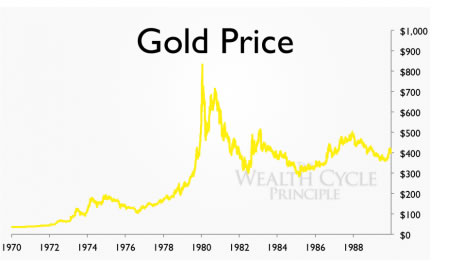
On the same day that silver hit $50 and silver futures topped out at $52.50, gold’s price set a new record of $850 and gold futures peaked at $892. COMEX, terrified that it would be forced into default, announced—with the backing of the CFTC—that trading in silver would be limited to liquidation orders only, eliminating any buyers.
With no new buyers, the price of silver could not go up. So this rule was basically the same as saying, “Until this rule is lifted, the price of silver will only go down.” Of course, silver began to plummet, and on that same day so did gold.
Was it just a coincidence that gold and silver peaked at the same time?
Could it be that many large silver traders also held gold?
Wouldn’t the gold traders on the exchanges have known what happened to the silver traders and said to themselves, “Oh my God…if they can do that to silver, then gold is probably next”?
From Billions to Bust
On Silver Thursday, silver dropped from $15.80 to $10.80 an ounce. The stock market also crashed, fueled by rumors that the Hunt brothers would liquidate stocks in order to cover their silver losses. Because most of their silver bullion had been purchased at under $10 an ounce, the Hunts were still ahead of the game on their physical silver. But in the futures market, where their average purchase price was near $35 an ounce, it was a different story.
It became easy for the government to label the Hunt brothers as market manipulators—both in the court of law and in the easily swayed court of public opinion. Bunker Hunt filed for personal bankruptcy and was charged with trying to corner the silver market. He settled with the IRS for $90 million and was fined an additional $10 million by the CFTC.7  
Why were the Hunt brothers torn down? Gold and silver are the canaries in the coal mine: Their spiking prices reflected the public’s loss of confidence in fiat currencies—like the U.S. dollar. So, the government and banking establishment had a vested interest in keeping gold and silver prices from exploding.
Do you think it’s possible that the Federal Reserve may have realized they could suppress the price of gold and save the dollar—while making it look like they were really protecting everyone by going after the Hunt brothers?
After scrutinizing the evidence, my conclusion is that the Hunt brothers were sacrificial lambs. The Hunt brothers broke no laws. The CFTC, COMEX and CBOT simply changed the rules in the middle of the game. And the U.S. government, eager to stop the rush to gold and silver that threatened the credibility of its own fiat currency, had no problem looking the other way.
Even Jeffrey M. Christian, Managing Director and founder of CPM Group and one of the world’s foremost authorities on the markets for precious metals, told me in an interview that he believed the Hunt brothers only added between 75¢ and $1.00 to the price of silver.
Silver Linings: What the Hunt Brothers Can Teach Us Today
The Hunt brothers got into trouble because they exposed themselves to a huge amount of risk through their leveraged investments. Leverage makes a bigger impact when you’re losing than it does when you’re winning: It can be as blunt as a bowling ball on the way up, but as sharp as a surgical laser on the way down.
In my view, there’s simply no substitute for physical ownership of your own gold and silver. This is especially important today, as we see the fiat currency system showing severe signs of instability.
Whether the Hunt brothers were victims of their own greed, the greed of board members on the exchanges, a desperate attempt by the Fed to save the dollar, or some combination of these things, it’s clear to me that the fall of silver in 1980 brought gold down with it and bought the dollar some extra time.
We have no way of knowing how high gold and silver would have gone if the government and banking establishment hadn’t gone after the Hunt brothers. We’ll never know if the dollar would have survived. We do know that gold peaked when silver peaked, and we know that gold fell when silver fell.
In the near future, both of these metals may again start taking off into the stratosphere. And this time, the Fed won’t have the Hunt brothers around to stop them.
- Mike Maloney
This is a free summary of the 2-part in-depth Hunt Brothers articles available to WealthCycles.com subscribers. Sign up for a free trial (no credit card or personal information required) to check out all the articles and analysis by Michael Maloney and the WealthCycles.com team.
Mike Maloney is the owner and founder of GoldSilver.com, an online precious metals dealership that specializes in delivery of gold and silver to a customer's doorstep, arranges for special secured storage, or for placement in one's IRA account. Additionally, GoldSilver.com provides invaluable research and commentary for its clients, assisting them in their wealth building endeavors.
© 2011 Copyright  GoldSilver - All Rights Reserved Disclaimer: The above is a matter of opinion provided for general information purposes only and is not intended as investment advice. Information and analysis above are derived from sources and utilising methods believed to be reliable, but we cannot accept responsibility for any losses you may incur as a result of this analysis. Individuals should consult with their personal financial advisors.


All information on this website is for educational purposes only and is not intended to provide financial advise. Any statements about profits or income, expressed or implied, does not represent a guarantee. Your actual trading may result in losses as no trading system is guaranteed. You accept full responsibilities for your actions, trades, profit or loss, and agree to hold MinKL Invest harmless in any and all ways.